
 Click magic potion to change backgrounds


Spiritual Significance of Swan
HAMSA GAYATRI MANTRA
Om Hamsaya vidhmaheParamahamsaya dhimahi
Tanno Hamsa pracodayat
May we realise Hamsa that is our own Self as swan
Let us meditate on that Paramahamsa, the Supreme Self
May Hamsa illumine us
Hamsa Gayatri, Haṃsagāyatrī (हंसगायत्री) refers to the Gāyatrī-form of the Haṃsa-Mantra, and is found in the Rig Veda, which is comprised of 10,028 Riks or hymns, not counting 11 supplementary hymns, spread over 10 books called Mandalas, a name that is also applied to the stellar constellations.
The Hamsa-gāyatrī is discussed in the fifteenth chapter of the Parāśarasaṃhitā, a Pañcarātra scripture, and is a form of the Gayatri mantra related to the concept of Hamsa (swan or goose).
GAYATRI : An ancient Vedic meter of 24 syllables generally arranged in a triplet.
MANTRA : A mystical formula of invocation or incantation (as in Hinduism).
The phrase 'Om Bhoor Bhuvah Svah' is generally added to the mantra, when it is recited.
Om represents the Supreme Consciousness, or God. Bhoor, Bhuvah, and Svah are the three planes or levels of consciousness. Bhuh/Bhoor (Earth) - Bhuvah (Atmosphere) - Svah/Swaha (Beyond atmosphere, Heaven)
Example: Gayatri Mantra
Why repeated 108 times
Namaste! This page lists references to swan and birds in a spiritual context, gathered from various websites and texts.
The purpose is mainly to identify possible correlations between my swan temple epiphany, and the knowledge contained within Vedic and Hindu scripture, songs, hymns, mantras, yoga, etc.
Prior to my blessed temple epiphany, I had no particular affinity for swans. I considered the birds elegant, and I'd sometimes watch them swim at parks, but that was the extent of my interest. However that greatly changed following my vision, visitation, or awakening. For me, swans now represent enlightenment, divinity, god.
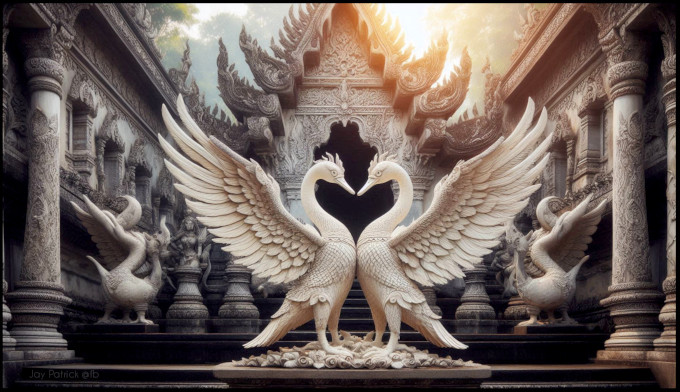
I usually refer to the two temple swans as "angels" for simplicity sake, and because I don't know who or what they actually are. Sometimes I refer to them as "So" and "Hum", simply because it correlates to the So'hum mantra.
Theoretically, however incredible, they might be a manifestation of Shiva and Shakti, or Lord Brahma and Krishna. But I honestly find it too fantastic to believe such supreme deities would appear unto me. The swans might also be the vehanas or vehicles of Brahma, Krishna or Saraswati.
Since I won't know until after I die ... I'll probably just stick to calling them Angels, or Hamsa.
Please change background if this one is unappealing. Menu at top corner.
Some swan related mythology, folklore, arts, music, and more may be found on On this page.

HAMSA हंस
HAMSA (Sanskrit: हंस, haṃsa or hansa): definitions:
1. White Swan, or aquatic bird of passage. It is believed by Hindus to be the vahana (vehicle) of Brahma, Gayatri, Saraswati, and Vishvakarma.
2. Soul / Spirit (Atman or Purusa).
3. In Yoga (union) Hamsa represents the "life force," or prana, that is summoned by the breath. Swan are a symbol of unity between body and soul, generally based on how swan are equally at home on both water and land.
4. Mountain; unambitious monarch; a kind of ascetic; silver; excellent draught-ox; man of supernatural qualities born under a particular constellation; to act or behave like a swan; horse; temple of a particular form; one of the vital airs; kind of mantra or mystical text.
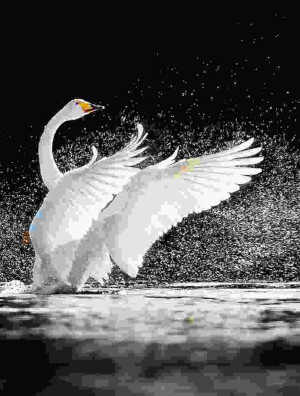
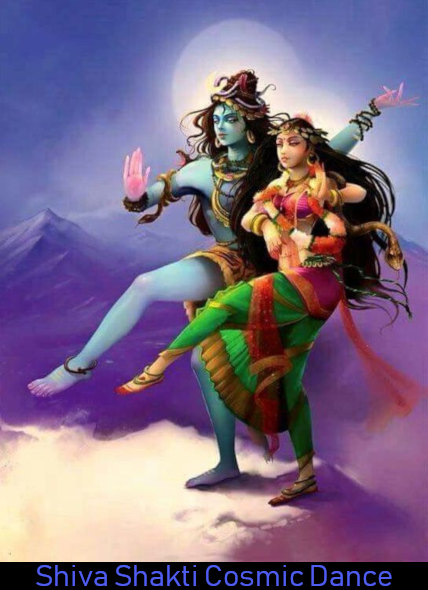
Hamsa represents the union of Shiva and Shakti, which are Ha and Sa, Sun and Moon, Prana and Apana, the incoming and outgoing vital energies. All dualities, starting with the breath, are a reflection of the greater two-in-one power of Shiva and Shakti, which gets divided in the lower worlds.
In terms of Tantric Yoga practices, the Hamsa represents the Shiva principle just as the Kundalini indicates the Shakti principle. Hamsa and Kundalini must unite and move together. It is the Kundalini that carries the Hamsa up the spine. At the same time, it is the Hamsa or soul energy that turns the Kundalini into a force of spiritual aspiration and ascent.
There are many forms of Hamsas dating back to the Rigveda where the Hamsa is primarily a solar symbol, the bird of light.
There are several types and colors of Hamsa, reflecting the cosmic energies that it is working with.
Shveta Hamsa – White Hamsa, the expansive power of the Moon, the Soma Hamsa, represented by the bija mantra Shrim (Shreem).
Nila Hamsa – Dark blue Hamsa, power of electrical energy or lightning, the Vidyut Hamsa, represented by the bija mantra Krim (Kreem). Here the dark blue is that of a rain cloud from which the streak of lightning arises.
Rakta Hamsa – Red Hamsa, the ascending force of Fire, Agni Hamsa, represented by the bija mantra Hum (Hoom).
Suvarna Hamsa – Golden Hamsa, the expansive power of the Sun and the heart, Surya Hamsa, represented by the bija mantra Hrim (Hreem).
Etymology: Hamsa in Indian tradition can refer to the migrating goose, swan or flamingo, and symbolizes the migrating soul or reincarnating soul.
The word Hamsa as a symbolism for Atman and moksha appears in numerous ancient texts of Hinduism.
The hymns of Rigveda, and verses in Hindu Epics and Puranas mention a variety of birds with the root of hamsa (हंस), such as
Maha-hamsa, Raj-hamsa, Kal-hamsa and others, most of which relate to various species of swans - particularly mute swan, while some refer to geese.
Compound Sanskrit Words Containing: hamsa
• Kalahamsa, in Vedanta philosophy, denotes the highest state of Hamsa, equating to Parabrahman. This concept embodies the ultimate reality or consciousness, signifying the pinnacle of spiritual understanding. Kalahamsa represents an advanced level of awareness that transcends ordinary perception, ultimately aligning with the essence of existence itself. This reflects a profound connection to the ultimate truth within the framework of Vedanta.
• Maha-hamsa (महाहंस) in Sanskrit refers to a large or great swan, and is also an epithet of Vishnu, and is used in the context of the Mahahamsa Jataka, a Buddhist story highlighting a king's ten duties.
• Rajahamsa (राजहंस) literally translates to "king of swans" or "royal swan," often used to describe a swan or a person of royal or noble stature, and can also symbolize wisdom and spiritual enlightenment.
Rājahaṃsa also refers to a type of temple (prāsāda) classified under the group named Sāndhāra, according to Samarāṅgaṇasūtradhāra chapter 56. The Sāndhāra group contains twenty-five out of a sixty-four total prāsādas (temples) classified under four groups in this chapter. The Samarāṅgaṇasūtradhāra is an 11th-century encyclopedia dealing with various topics from the Vāstuśāstra.
• bhakta-haṁsa — the devotees, who are just like swans [Madhya 25.274]
• haṁsa-śaraṇam — the shelter of the liberated souls [SB 4.29.55] SB: Śrīmad-Bhāgavatam
• haṁsa-śriyoḥ — as beautiful as white swans [SB 3.15.38]
• haṁsa-madhye — in a society of white swans [Antya 5.129]
• haṁsa-vāhanaḥ — Lord Brahmā, who rides a swan airplane. [SB 7.3.15-16]
• kala-haṁsa — swans [SB 4.3.12]
K.N. Dave surmised the hamsa swan identification is based on the details provided in the Sanskrit texts about the changes in plumage over the bird's life, described voice, migratory habits, courtship rituals and flying patterns. Some Sanskrit texts distinguish between Hamsa and Kadamb, the former being swan and latter as bar-headed goose. Regardless of whether it is goose or swan, the word in the Upanishad title is symbolism for something that migrates, is transcendent.
The text title likely refers to it being a treatise for individual soul, seeking the highest soul (Paramahamsa).
SOHAM - HAMSA MANTRA - हंसमन्त्र
Who am I ?
I am that
I am that I am
I myself am the Swan

Soham or Sohum (सो ऽहम् so 'ham or so 'Hum is a Hindu mantra, meaning
"I am He/That" in Sanskrit. In Vedic philosophy it means identifying oneself with the universe or ultimate reality.
The mantra is also inverted from so 'ham (the sandhi of saḥ + aham) to ham + sa.
The combination of so 'haṃ haṃsaḥ has also been interpreted as "I myself am the Swan", where the swan symbolizes the Ātman (inner self, spirit, soul).
Saḥ सः and aham अहम् put together becomes so'ham सोऽहम् because of Sanskrit sandhi rules. The apostrophe represents the missing a.
Mantra is the sound-body of god; as the tree is contained in a seed, Brahmanda (Brahman + Anda = Brahman's Egg = Brahman's universe) is contained in the Mantra, Hamsa Mantra.
Siva and Sakti throb in this Mantra. There is no life without this Mantra; it is integral to life and breathing, not only inspiration and expiration of air but the internal breathing of each cell. To exemplify this fact it is said that Hamsa Mantra is like light in the sun, oil in the sesamum seed, fire in the wood, Sakti in Siva, movement in the wind.
Haṃsamantra (हंसमन्त्र) is explained by Lakṣmaṇadeśika in his 11th-century Śaradātilaka.—When one blocks the sense organs with one’s fingers and meditates on the identity of the Self, the vital breath (prāṇa) and the mind (manas) while retaining one’s breath, the inner sound (nāda) is heard and the knowledge of the haṃsaḥ arises. Haṃsaḥ is the sound heard with exhalation and inhalation, also called the “non-recitation” (ajapā) Gāyatrī.
Haṃ is considered male (puṃs, puruṣa), and saḥ female (prakṛti). With constant practice of the haṃsaḥ mantra, the stage is reached in which the mantra reverses itself and, after the application of a saṃdhi rule, becomes so’haṃ (“He I am”). In the next stage the letters s and h disappear, and after vowel substitution the mantra becomes the sacred syllable oṃ, referred to as the praṇava.
“Think always "Soham, Soham"; this is almost as good as liberation. Say it day and night; realisation will come as the result of this continuous cogitation. This absolute and continuous remembrance of the Lord is what is meant by Bhakti.” -Complete Works of Swami Vivekananda
Inhale: So - Exhale: Ham or Hum
Soham Mantra Example [download]
References and Related InfoSo'ham Mantra Meaning, Benefits and PurposeHamsa mantra in Shaktism (Shakta philosophy) Mantra - Veeraswamy Krishnaraj Wikipedia - Soham (Sanskrit) Hunsani Meditation on the white swan Hamsa (Swan) Breath Meditation Hanas Yoga The Elixir Of Self Realization ~ Soham Sadhana Free ebook / pdf by Sriram Sharma Acharya *Image credit: "The Invocation" by Patricia Brennan |
HAMSA UPANISHAD - Hamsopanisad
हंसोपनिषद्
The Hamsa Upanishad is a Sanskrit text and a minor Upanishad of Hinduism. It is classified as one of the twenty Yoga Upanishads, and attached to the Shukla Yajurveda.
This Upanishad talks about the famous Sanskrit term "Hamsa". This Upanishad is part of the Sukla Yajur Veda.
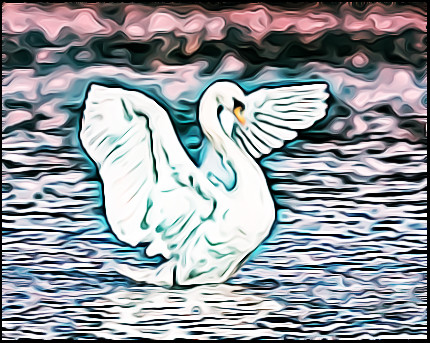 The Hamsa Upanishad teaches an ascent through six mystical circles [chakras, lotuses, vortexes] on to the Brahmarandhra at the top of the head. This ascent is had by meditation of the syllable Om as it becomes audible within. Hamsa repetition may help that "thunder", the medley sound called OM, to come to the fore. Then it is fit to keep it audible as long and often as you can.
This mantra-king (hamsa) has a symbolical interpretation - the individual Atman (soul) is conceived in the form of a bird, a Hamsa (goose, duck, swan).
It is told that the Hamsa and the Paramahamsa (Supreme Swan) are one - that is, the individual and the highest Atman (Spirit) are one and the same in essence.
References and Related InfoHamsa Upanishad WikiHamsa Upanishad Sacred-texts 30 Minor Upanishads (text) Birds in Sanskrit Literature K.N. Dave Yoga Upanishads PDF (see p.537-547) |
Śrīmad-Bhāgavatam
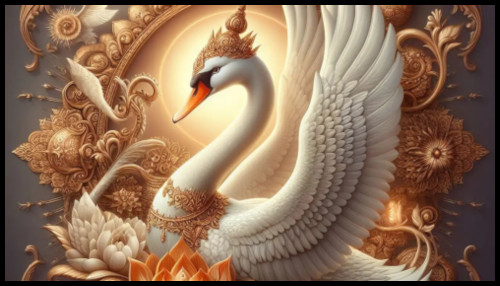
The Srimad Bhagavata is one of the main books of Hindu philosophy.
The Bhagavata is a devotional account of the Supreme Being and His incarnations. Book 1 of the Srimad Bhagavata discusses the origin of the Bhagavata, and introduces the reader to the glories of Krishna as the Supreme Lord. This book consists of 19 chapters. The Bhagavata is authored by Veda Vyasa, वेदव्यास, lit. 'the one who classified the Vedas'.
'Bhagavata' (or 'Bhagavatam' or 'Bhagavat', Sanskrit भागवत) means 'follower or worshipper of Vishnu'.
ŚB 11.13.19
स मामचिन्तयद् देव: प्रश्नपारतितीर्षया ।
तस्याहं हंसरूपेण सकाशमगमं तदा ॥ १९ ॥
sa mām acintayad devaḥ
praśna-pāra-titīrṣayā
tasyāhaṁ haṁsa-rūpeṇa
sakāśam agamaṁ tadā
Translation:
Lord Brahmā desired to attain the answer to the question that was puzzling him, and thus he fixed his mind on Me, the Supreme Lord. At that time, in My form of Haṁsa, I became visible to Lord Brahmā.
Similarly, Lord Kṛṣṇa appeared as Haṁsa, or the swan, in order to separate the pure consciousness of Lord Brahmā from the modes of material nature.
Srimad Bhagavata 11.13.19Supreme Lord appeared before him in the form of the swan incarnation, Lord Haṁsa. Lord Haṁsa proceeded to give instructions about the categorical identity of the self, the different states of consciousness (wakeful awareness, sleep and deep sleep) and the means for conquering over material existence.
ŚB Chapter 13 Haṁsa-avatāraIn Hindu mythology, the story of Lord Brahma’s Hamsa avatar holds a special place. According to ancient texts, when the universe was still in its primordial state, Lord Brahma sought a way to bring order and harmony to the chaotic cosmos.
It is said that he assumed the form of a majestic Hamsa, adorned with resplendent plumage and exuding an aura of divine grace.
Generations have passed down the tale of Lord Brahma’s Hamsa avatar, yet its deeper meanings and esoteric teachings shroud it in mystery. Some scholars interpret the Hamsa as a metaphor for the soul’s journey towards liberation. Others see it as a symbol of cosmic harmony and balance.
Mysteries of Lord Brahma’s AvatarMAHANIRVANA TANTRA
महानिर्वानतन्त्र
The Mahanirvana Tantra is known as the Great Liberation Tantra because it contains all the Dharmmas, while the others deal with one subject only.
The Mahanirvana Tantra speaks about the significance of "soham" or "hamsa", used in both meditation and chanting as the means to self-realization. Both the words symbolize the ultimate reality hidden in the manifest creation and contain in themselves both the masculine and feminine aspects of creation, namely Siva and Shakti, represented by the sounds "ham" and "sa" respectively. Hamsa, means the swan and also " I am He". It is equated with the sound of natural breathing because the sound of our natural breathing is very similar to the sound of hamsa. When chanted repeatedly hamsa (I am He) sounds like soham (He is I am) or vice versa. Thus it is said that by breathing naturally every living being chants unknowingly and spontaneously, one of the most powerful mantras in the world, which is regarded as the pranava itself. Through breath all beings continuously worship God, remind themselves of their true nature and connection with God and identify themselves with Him.
Dhyana (Sanskrit: meditation or contemplation):
In the morning meditate upon Her in Her Brahmi form, as a Maiden of ruddy hue, with a pure smile, with two hands, holding a gourd full of holy water, garlanded with crystal beads, clad in the skin of a black antelope, seated on a Swan [1]
Suvrata! listen to the meditation on Brahma and Ananta. Brahma is of the colour of the red lotus, and has four hands and four faces. He is seated on a swan. With two of his hands he makes the signs which dispel fear and grant boons, and in the others he holds a garland and a book. Ananta is white as the snow, the Kunda flower, or the Moon. He has a thousand hands and a thousand faces, and he should be meditated upon by Suras and Asuras. [2]
References and Related Info[1] Chapter 5 (56)[2] Chapter 13 (99-101) Mahanirvana Tantra Chapter Index Hamsa, Soham; Mahanirvana Tantra |
SARASWATI
सरस्वती
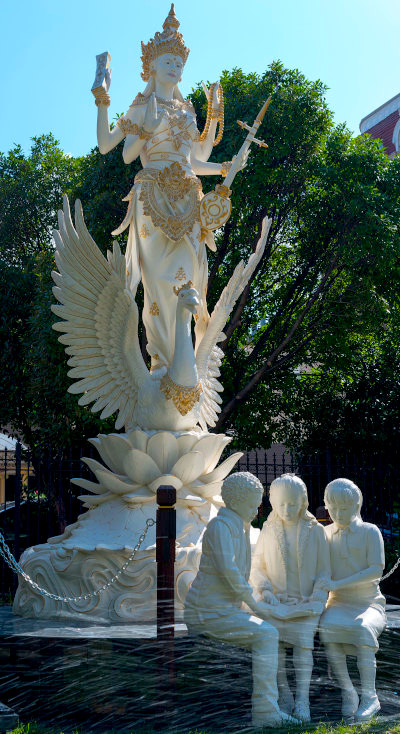
Saraswati (also Sarasvati) is the Hindu goddess of learning, wisdom, music, and aesthetics.
She is also known as Bharati (eloquence), Shatarupa (existence), Vedamata ('mother of the Vedas'), Brahmi, Sarada, Vagisvari, and Putkari. As Vac, she is the goddess of speech. Saraswati first appears in the Rigveda and, in later religious texts, she is identified as the inventor of Sanskrit and, appropriately, gives Ganesha the gifts of pen and inks. She is also a patron of the arts and sciences, and the wife of Brahma, even if the Bengal Vaisnavas considered her first the wife of Vishnu. Sarasvati is also worshipped as the goddess of learning in Jainism and by some Buddhist sects.
In Hindu art, Saraswati is usually depicted as a graceful youth with white skin. She most often wears a white sari (which symbolises purity) which has a blue border. Not being concerned with worldly goods she rarely wears jewelry. She may have a crescent on her forehead and be seated on a lotus flower. Alternatively, she may be shown riding her vehicle (vahana), either a swan or goose.
The Sanskrit word Saraswati (सरस्वती) is a combination of the words saras (सरस्) and vati (वती). It translates to "she who possesses pooling water" or "she who possesses speech".
Saras: (सरस्) Means "pooling water", "speech", "a lake", "pond", "pool", or "a large sheet of water".
Vati: (वती) Means "she who possesses".
36. Female swan amidst the cluster
Of the faces of the four-faced god –
May the all-white Sarasvati
Sport for ever in my mind !
References and Related InfoSarasvati-rahasya UpanishadAncient.eu: Sarasvati Image source |
PARAMAHAMSA
परमहंस
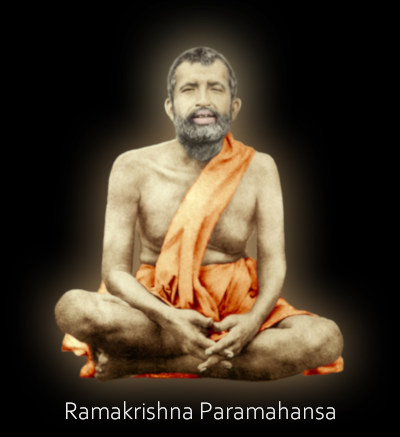
Paramahamsa, also spelled paramahansa or paramhansa, is a Sanskrit religio-theological title of honor applied to Hindu spiritual teachers who are regarded as having attained enlightenment. The title literally means "supreme swan," and symbolizes spiritual discrimination.
"Who may be called a paramahamsa? He who, like a swan, can take the milk from a mixture of milk and water, leaving aside the water. He who, like an ant, can take the sugar from a mixture of sugar and sand, leaving aside the sand."
~Sri Ramakrishna Paramahamsa
References and Related Info
|
Paramahamsa Wiki 'Great Swan: Meetings with Ramakrishna' by author Lex Hixon. |
SOUNDARYA LAHARI
सौन्दर्यलहरी
The Soundarya Lahari, meaning "Waves Of Beauty" is a famous literary work in Sanskrit believed to be written by sage Pushpadanta and Adi Shankara. Its hundred and three shlokas (verses) eulogize the beauty, grace and munificence of Goddess Parvati / Dakshayani / Shakti, consort of Shiva.
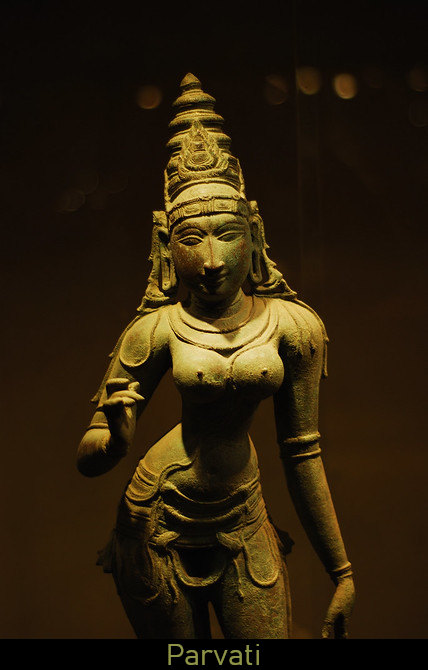
The Soundarya Lahari is not only a poem. It is a tantra textbook, giving instructions on Puja and offerings, many yantras, almost one to each shloka; describes tantric ways of performing devotion connected to each specific shloka; and details the results ensuing therefrom.
The Soundarya Lahari is often viewed as being composed of two parts.
Verses 1 - 41 describe the mystical experience of the union of Shiva and Shakti and related phenomena.
First 41 verses cover the detailed account of internal worship of the Mother. It consists of systematic exposition of the concept of kundalini, Sri Chakra, mantras (verses 32, 33). This depicts the Supreme Reality as non-dual but with a distinction between Shiva and Shakti, the power holder and Power, Being and Will. The Power, that is, the Mother or Maha Tripura Sundari, becomes the dominant factor and the power holder or Shiva becomes a substratum.
Translations vary, but swans are definitely mentioned twice.
(Verse / Stanza 38 & 91).
Verse 38:
Samunmeelath samvithkamala makarandhaika rasikam
Bhaje hamsadwandham kimapi mahatham maanasacharam
Yadhalapaa dhashtadasa gunitha vidhyaparinathi
Yadadhathe doshad gunamakhila madhbhaya paya eva
I pray before the swan couple,
Who only enjoy the honey,
From the fully open,
Lotus flowers of knowledge,
And who swim in the lake,
Which is the mind of great ones,
And also who can never be described.
From them come the eighteen arts,
And they differentiate the good from the bad,
Like the milk from water.
Here the two swans refer to Shiva and Shakti.
The eighteen arts mentioned in Shlokam No. 38 are;
4 Vedas, Siksha, Kalpam, Vyakaranam, Niruktam, Sandas, Jyotisham, Meemamsam, Nyayam, Puranam, Dharma Shastram, Ayurvedam, Dhanurvedam, Gandarva Vedam and Needi Shastram.
Verse 91: O Goddess of Holy Fame! The royal Swans inhabiting Thy residence are never abandoning their pursuit of Thee, in their effort to observe Thy gait for correcting their own defective ways.
And Thy lotus feet are, it seems, giving instructions to them in the guise of the tinkling sounds made by the anklets on them, studded with precious stones.
"O Goddess of Holy Fame" is a phrase most likely invoking Kirti, usually considered the consort of Vishnu.
References and Related InfoSoundarya Lahari English translationSoundarya Lahari PDF (p.64 : Verse 38) |
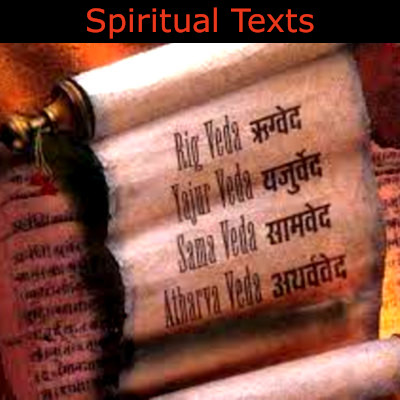
Rig Veda ऋग्वेद
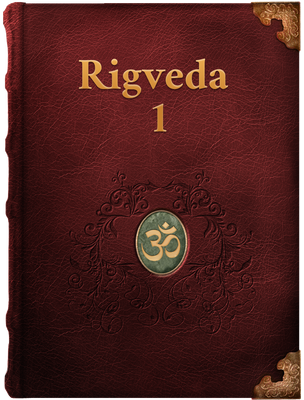
The Rigveda ऋग्वेद, IAST: ṛgveda, from ऋच्, "praise" and वेद, "knowledge") is an ancient Indian collection of Vedic Sanskrit hymns (sūktas). It is one of the four sacred canonical Hindu texts (śruti) known as the Vedas. Only one Shakha of the many survive today, namely the Śakalya Shakha. Much of the contents contained in the remaining Shakhas are now lost or are not available in the public forum.
Below are some hymns in which swans or hamsa are mentioned.
ōṃ haṃ̠sa̠ haṃ̠sāya̍ vi̠dmahē̍ paramahaṃ̠sāya̍ dhīmahi ।
tannō̍ haṃsaḥ prachō̠dayā̎t ॥
(haṃsagāyatrī)
May we realise Hamsa that is our own Self as swan
Let us meditate on that Paramahamsa, the Supreme Self
May Hamsa illumine us
The Gayatri Mantra is a part of the Medha-Suktam मेधासूक्तम् (Taittiriya Aranyakam-4, prapatak-10, Anubak 41-44).
Medha Suktam HindiMedha Suktam Wiki
• HYMN CXXIV. Agni, Etc.: 9. They call him Swan, the abhorrent floods' Companion, moving in friendship with celestial Waters.
• HYMN LXV: Agni: 5. Like a swan sitting in the floods he pants wisest in mind mid men he wakes at morn.
• HYMN CLXIII: The Horse: 10. Symmetrical in flank, with rounded haunches, mettled like heroes, the Celestial Coursers Put forth their strength, like swans in lengthened order, when they, the Steeds, have reached the heavenly causeway.
• HYMN XXXIV: Maruts: 5. With brightly−flarning kine whose udders swell with milk, idth glittering lances on your unobstructed paths, O Maruts, of one mind, like swans who seek their nests, come to the rapturous enjoyment of the meath.
• HYMN VIII Sacrificial Post: 9. Like swan's that flee in lengthened line, the Pillars have come to us arrayed in brilliant coIour. They, lifted up on high, by sages, eastward, go forth as Gods to the God's dwelling−places.
• HYMN LIII: Indra, Parvata, Etc.: 10. Like swans, prepare a song of praise with pressing−stones, glad in your hymns with juice poured forth in sacrifice.
• HYMN XLV: Asvins: 4. The swans ye have are friendly, rich in store of meath, gold−pinioned, strong to draw, awake at early morn, Swimming the flood, exultant, fain for draughts that cheer: ye come like flies to our libations of−the meath.
• HYMN LXXVIII: Asvins: 1. YE Asvins, hither come to us: Nasatyas, be not disinclined. Fly hither like two swans unto the juice we shed.
2. O Asvins, like a pair of deer, like two wild cattle to the mead: Fly hither like two swans unto the juice we shed.
3. O Asvins rich in gifts, accept our sacrifice to prosper it: Fly hither like two swans unto the juice we shed.
• HYMN LIX: Maruts: 7. Decking the beauty of their forms in secret the Swans with purple backs have flown down hither. Around me all the Company hath settled, like joyous Heroes glad in our libation.
• HYMN XXXV: Asvins: 8. Ye fly like swans, like those who travel on their way; like buffaloes ye seek the Soma we have shed. Accordant, of one mind with Surya and with Dawn, come thrice, O Asvins, to our home.
• HYMN XCVII: Soma Pavamana: 8. The Swans, the Vrsaganas from anear us have brought their restless spirit to our dwelling. Friends come to Pavamana meet for praises, and sound in concert their resistless music.
• HYMN XCV: Urvasi. Pururavas: 9. When, loving these Immortal Ones, the mortal hath converse with the nymphs as they allow him. Like swans they show the beauty of their bodies, like horses in their play they bite and nibble.
• HYMN XL: Dadhikravan: 5. The Hamsa homed in light, the Vasu in mid air, the Priest beside the altar, Guest within the house, Dweller in noblest place, mid men, in truth, in sky, born of flood, kine, truth, mountain, he is holy Law.
VIVEKANANDA
The Ramakrishna Order emblem was designed by Swami Vivekananda.

The wavy waters in the picture are symbolic of Karma, the lotus of Bhakti, and the rising-sun of Jnana. The encircling serpent is indicative of Yoga and awakened Kundalini Shakti, while the swan in the picture stands for Paramatman. Therefore, the ideal of the picture is that by the union of Karma, Jnana, Bhakti and Yoga, the vision of the Paramatman is obtained.
In Hindu philosophy, Paramatman परमात्मन् - is the universal or eternal Soul. It is one of two types of souls -- the other being jiva-atman, which is the individual soul or self. The term comes from the Sanskrit parama, meaning “highest” or “supreme,” and atman, meaning “self,” “soul” or “individual spirit.” In English, it is roughly translated to mean “primordial self” or "the self beyond.
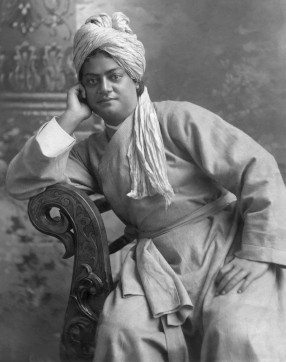 The word, Paramatman, is not to be found in the Rig Veda but through allusion referring to Paramatman as Isha or īśá ईश (master, lord). This distinction is made because all of its mantras which in the form of prayers are addressed to gods. In its great Riddle Hymn (Sukta I.164) is the famous mantra - R.V.I.164.20, that was revealed to Rishi Deergatamaah Auchathyah and borrowed by Mundaka Upanishad III.1.1-3, which belongs to Atharva Veda, to weave the parable of the Two Birds.
Parable of the Two Birds
In a Mundaka Upanishad parable it is said that there are two birds sitting on the same bough, one of which feeds and the other looks on. This is an image of mutual relationship of the infinite being and the finite self. The delight of the bird which looks on is great, for it is pure and free delight.
There are both of these birds in man himself, the objective one with its business of life, the subjective one with its disinterested joy of vision.
"The two birds are the Jiva and Isvara, both existing in an individual compared to a tree. They exist together as the reflection and the original. They both manifest themselves in different ways in every individual".
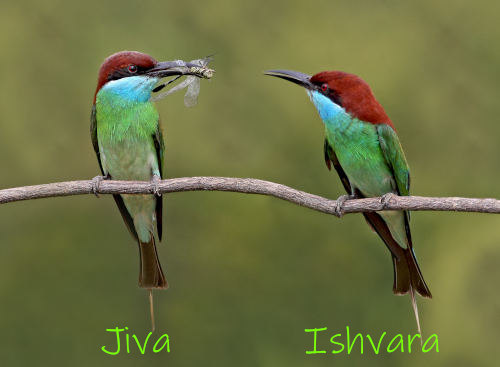
Sayana says that the two Birds are the vital and the Supreme Spirit, dwelling in one body. The vital spirit enjoys the fruit or rewards of actions while the Supreme Spirit is merely a passive spectator. The fine Birds are perhaps the priests, and the Keeper of the Universe may be Soma. Sayana explains suparņā, well-winged, in this and the preceding stanza as smooth-gliding (rays). Their offspring is, he says, the light, and the Father is the cherishing and protecting Sun. All explanations of these three stanzas can only be conjectural figments and that they have been inserted together in this hymn merely because the word suparņā ā (used apparently in various senses) has prominent place in each stanza. Suparņā (dual) has been explained by different scholars as two species of souls; day and night; Sun and Moon; (plural) as rays of light; stars; metres; spirit of the dead; priests; and the tree on which they rest as the body; the orb or region of the Sun; the sacrificial post; the world; and the mythical World-Tree.
References and Related Info:
 Although unrelated to swan, the Hamsa Hand is a universal sign of protection, power, and strength that dates back to ancient Mesopotamia. Known as the Hand of Fatima in Islam and the Hand of Miriam in Judaism, it's believed to protect against the evil eye and all negative energies.
The word “Hamsa” means “five,” representing the fingers of the right hand. For Hindus and Buddhists, it symbolizes chakras, energy flow in the body, the five senses, and the mudras that affect them.
Page Content
Swan related mythology, folklore, arts, music, and more may be found on On this page.
Site Spiritual Articles

Swan Images
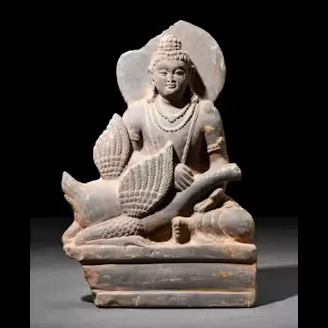 Gandhara Schist Statue of Siddhartha Nursing a wounded swan; circa 3rd-4th century AD |
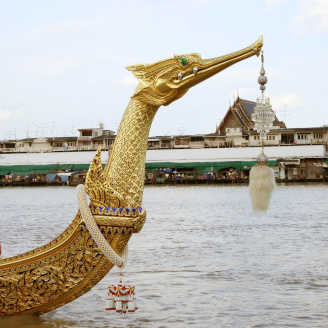 Suphannahong Royal Barge Golden Swan Bow Thailand |
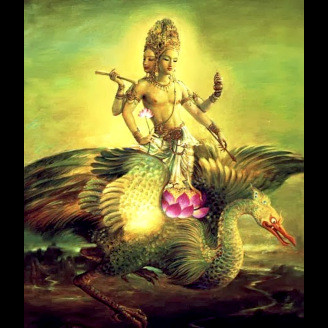 Brahma ब्रह्मा Riding a Swan (Vahana, Vehicle, Mount) |
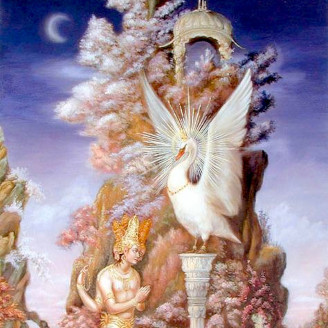 Lord Brahma |
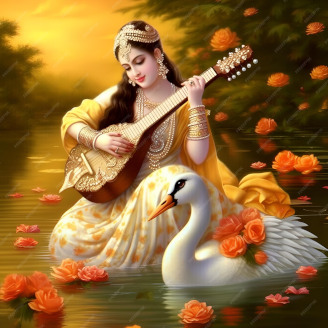 Saraswati playing Veena |
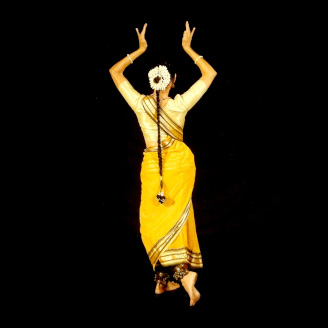 Hamsapaksha Mudra |
| Comments |
|---|
| *1000 character limit |