
 Click magic potion to change backgrounds


Swan Mythology and More
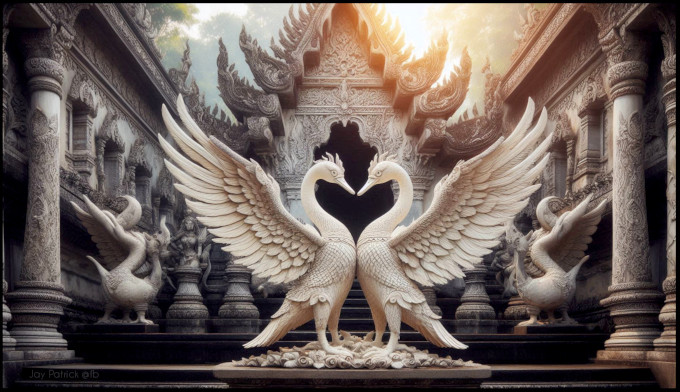
This section bears no direct relevance to my Swan temple epiphany.
It's just a place to gather swan related mythology, folklore, the arts, music, and spiritual or historical references.
Should you comment, bear in mind this page content is unfinished and may change a lot over time.
Leda and the Swan
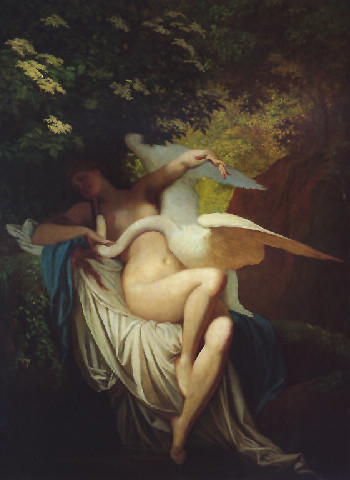
The myth of Leda and the Swan tells the story of Zeus, the king of the gods, who transformed into a swan to seduce or rape Leda, the queen of Sparta. From this union, Leda laid two eggs, which hatched four children: Helen and the demigod Pollux (both fathered by Zeus), and the mortal Castor and Clytemnestra (both fathered by her husband, Tyndareus). This myth is famous for its impact on Greek mythology, as it led to the birth of Helen of Troy and ultimately the Trojan War.
Castor and Pollux (the Dioscuri) were twins who were considered inseparable, and the pair were highly regarded heroes in Greek mythology. When young, the twins would lead the Spartan army against Athens, to retrieve the abducted Helen. Then later in life they would be counted as members of the Argonauts, on the quest for the Golden Fleece, and would also be amongst the hunters of the Calydonian Boar.
Ancient Greece and Rome
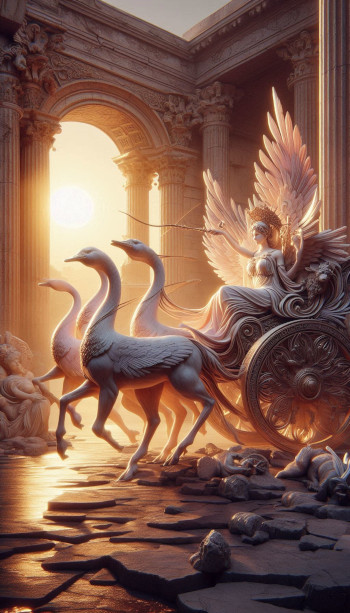
Swans were sacred to several deities in ancient cultures. In Greek tradition, the swan was connected to Apollo, the god of music, and was said to sing its most beautiful song just before death, inspiring the term "swan song". The swan was also sacred to Aphrodite and Venus, the goddesses of love and beauty.
In Greek vase paintings and Roman poetry, the swan is often shown accompanying the goddess Aphrodite, highlighting the harmony between grace and power. Because swans mate for life, they are considered symbols of faithfulness, monogamy, and deep romantic devotion.
Swans are sacred to Apollo, the god of music, prophecy, and light, often symbolizing grace, beauty, and poetic inspiration. They are closely linked to his birth on Delos, where they circled the island seven times, and are frequently depicted pulling his chariot or being ridden by him.
Hyacinthus’ apotheosis is symbolized through his association with swans, creatures intrinsically linked to Apollo’s identity. Apotheosis, deriving from the Greek apotheoun ("to make a god"), is the formal elevation of a human, entity, or idea to divine status, or the highest, most perfect example of something.
It represents the ultimate climax or glorification, acting as a bridge between the mortal and divine. Ancient sources describe Hyacinthus accompanying Apollo across the god’s sacred lands in a chariot drawn by swans.
Swans were mythologically associated with Hyperborea, a mystical land of perpetual spring and immortality where Apollo was said to retreat during winter. As the poet Pindar recounts, “…to the shrine of Apollo the swans of Hyperborea fly, circling in chorus round his temple, their songs weaving harmony with his lyre.” This vivid imagery firmly establishes the swan as a celestial messenger, bridging the mortal realm with Apollo’s ethereal Hyperborean domains.
In Roman times, Latin poets, such as Ovid and Horace, referred to the goddess Aphrodite in her chariot being drawn through the air by swans.
Celtic & Norse Mythology
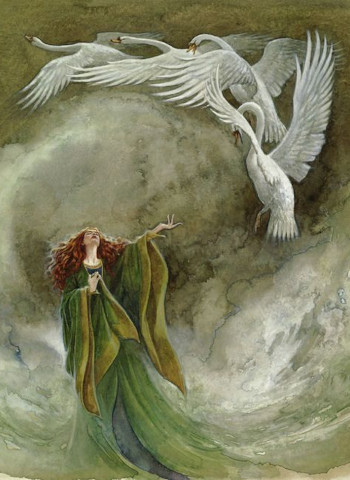
In Irish folklore, swans are connected to the "Otherworld," a mystical realm that exists parallel to our own. Some legends, like that of the Children of Lir, feature humans who are transformed into swans for centuries, enduring with their human spirits intact. The Celts also linked swans to powerful entities, such as the Valkyries in Norse mythology, who could transform into swans to travel between earthly and divine realms.
Swan Maidens: In Norse and Germanic folklore, swan maidens were supernatural female creatures who could turn into swans by wearing a special feathered skin or garment. In Norse myth, some Valkyries were said to be swan maidens, who flew through the air to collect fallen warriors.
The Children of Lir is a tragic Irish legend about four siblings—Fionnuala, Aodh, Fiachra, and Conn—transformed into swans for 900 years by their jealous stepmother, Aoife. As children of the sea god Lir and his wife Aobh, they endured three 300-year periods of exile on different Irish waters before breaking the spell, turning into old humans, and dying.
Closeburn Castle Swans
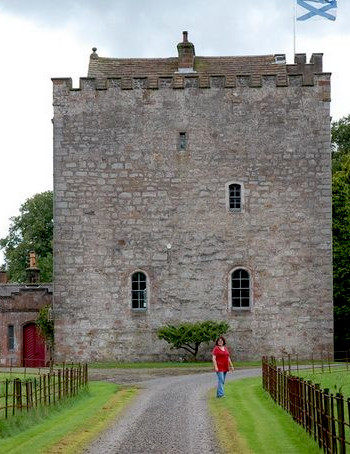
Closeburn Castle, a defensive tower, became the ancestral home of the Kirkpatricks in 1232, when the land was granted to Ivone of Kirkpatick by Alexander II, King of Scotland.
It is the oldest continuously inhabited tower house in Scotland.
Legend tells of an ancient loch on the castle grounds. Each spring two Mute swans would appear on this loch, and they were seen as harbingers of good fortune and health.
Unfortunately some time in the 15th century, Robert, a 13 year-old heir to Closeburn, shot one the swans with a crossbow, killing the beautiful bird. It is said this occurred shortly after he attended a performance of The Merchant of Venice at the Edinburgh theatre.
In the course of the play, he was surprised to hear Portia say of Bassanio that he would:
Make a swanlike end. [1]
Robert's motive is unclear. Perhaps he killed this swan to dispell the myth that swans sing when they die, or that the castle swans held any magical or spiritual significance.
It is told from that time on, a ghostly white swan with a blood-stained breast would appear on the loch whenever one of the Kirkpatrick chiefs was about to die.
The last recorded appearance of the bird was at the third nuptials of Sir Thomas Kirkpatrick, the first baronet of that name. On the wedding day his son Roger was walking by the lake, when suddenly as if it had emerged from the waters, the swan with the bleeding breast appeared. Roger had heard of the mysterious swan, and although his father’s wedding bells were ringing merrily, he returned to the castle a sorrowful man, for he felt convinced that some darkness was hanging over him. On that very night Roger died, and here ends the strange story of the swans of Closeburn.
The castle loch was dredged and filled with earth over a century ago, and the swans are long gone, but the legend lives on.
Closeburn Castle website Now featuring escape room adventures and tours.
Kirkpatrick web
Random-Times
Victorian Book of the Dead
Closeburn Castle Wiki
[1] The Merchant of Venice; Act 3, Scene 2
The Swan Knight
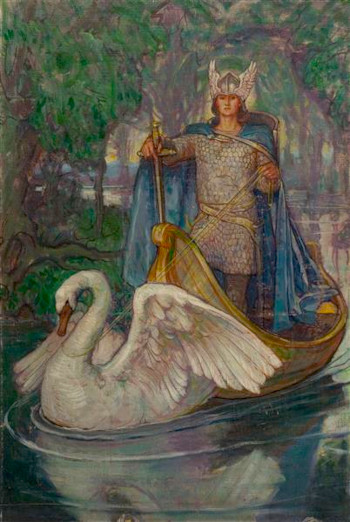
The "Swan Knight" is a legendary figure, often named Lohengrin or Helyas, who arrives in a swan-drawn boat to defend a damsel in distress, forbidden from revealing his origin. While distinct from the core Arthurian legend, this tale was integrated into German and French Arthurian-related romances, sometimes linked to the ancestry of crusader Godfrey of Bouillon.
Lohengrin (German: [ˈloːənɡʁiːn]) is a character in German Arthurian literature. The son of Parzival (Percival), he is a knight of the Holy Grail sent in a boat pulled by swans to rescue a maiden who can never ask his identity. His story, which first appears in Wolfram von Eschenbach's Parzival, is a version of the Knight of the Swan legend. known from a variety of medieval sources. Wolfram's story was expanded in two later romances. Richard Wagner's opera Lohengrin of 1848 is based upon the legend.
Native American Traditions
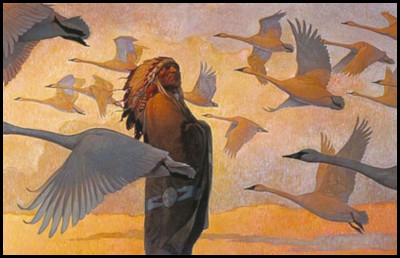 The swan is a messenger from the spirit world for many Native American tribes. Its feathers are sometimes used in ceremonies for healing and protection. The swan is also associated with the Great Spirit, symbolizing its power and wisdom.
According to Jamie Sams and David Carson, who collected Native American tales from elders in the Choctaw, Lakota, Seneca, Aztec, Yaqui, Cheyenne, Cherokee, Iroquois, and Mayan traditions, Swans represented ‘Grace’.
Swan tells Dragonfly in legend, ‘I learned to surrender my body to the power of Spirit and was taken to where the future lives. I saw many wonders high on Sacred Mountains and because of my faith and my acceptance I have been changed.
I have learned to accept the state of grace.’
Swan is the bird who may enter the Dreamtime and bring back knowledge and healing to the tribe. Swan medicine ‘teaches us to be at one with all planes of consciousness, and to trust in Great Spirit’s protection.’ (Medicine Cards, pages 192-195)
In Navajo tradition, the Great White Swan can call up the Four Winds. Native American swan dances are sacred, interpretive performances honoring the bird's grace and spiritual significance, historically featured by the Ho-Chunk and Ojibwa peoples. The Yakama Nation’s "Little Swans Dancers" perform songs and dances derived from legends of the species.
Alchemy
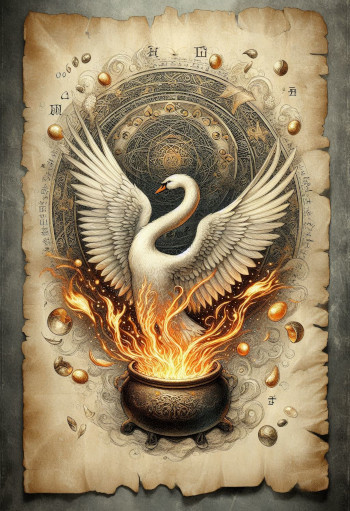
In alchemical symbolism, the white swan represents the Albedo stage, a phase of whitening that follows the black stage, symbolizing spiritual purity and the potential for transformation.
Alchemists observed that when certain materials were heated, white crystals resembling floating swans would form. Thus in alchemy, the swan symbolizes purification — where the soul is freed from impure matter — and it represents the union of opposites, such as water/air or male/female. It indicates the refinement of the spirit during the creation of the philosopher's stone.
The philosopher's stone is a legendary alchemical substance, often described as a red or white powder, and sometimes as a solid, transparent or glass-like substance, which was reputed to transmute base metals (like lead) into gold or silver, and create the Elixir of Life for immortality. It was the ultimate goal of medieval and Renaissance alchemists, representing spiritual and physical perfection.
Mythological Aspect: The swan bridges heaven and earth, representing a transformation that combines air and water elements. Swans are equally at home in air, water, and on land or earth. The swan is frequently depicted in alchemical art alongside the crow (nigredo), peacock (cauda pavonis), and phoenix (rubedo) as part of the transformational stages.
Astronomy
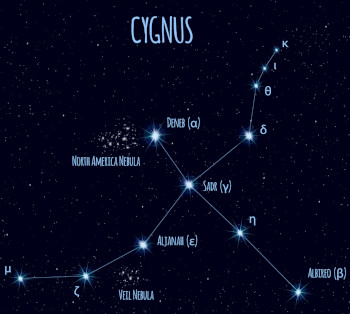
Cygnus, Latin for "swan," is a northern constellation, also known as the Northern Cross for the cross-shaped asterism formed by its brightest stars. It is best seen in late summer and early autumn and lies along the plane of the Milky Way, making it rich in deep-sky objects like nebulae and star clusters. Its brightest star, Deneb, is part of the prominent Summer Triangle asterism, along with Vega in Lyra and Altair in Aquila.
This constellation contains over 60 stars. Deneb (Alpha Cygni), is a luminous white supergiant that marks the swan tail. Other key stars include Albireo (Beta Cygni) at the head and Sadr (Gamma Cygni) at the center.
Key Stars in Cygnus:
Deneb (Alpha Cygni): The 19th brightest star in the sky, it is a blue-white supergiant located roughly 2,600 light-years away.
Albireo (Beta Cygni): A popular double star for amateur astronomers, featuring a contrasting orange-hued giant and a blue-green companion.
Sadr (Gamma Cygni): Located at the intersection of the Northern Cross, this yellow-white supergiant is surrounded by the diffuse emission nebula IC 1318.
Fawaris (Delta Cygni): A bright binary star system that forms part of the swan's wings.
Aljanah (Epsilon Cygni): A giant star located near the Veil Nebula.
Zeta Cygni (ζ Cyg): A binary star system with an apparent magnitude of 3.26.
Significant Celestial Features:
Cygnus X-1: A famous binary star system containing a confirmed black hole.
The Veil Nebula: A large supernova remnant.
North America Nebula (NGC 7000): An emission nebula near Deneb.
Cygnus Rift: A prominent dark cloud of dust obscuring the Milky Way.
Symbolism in Art
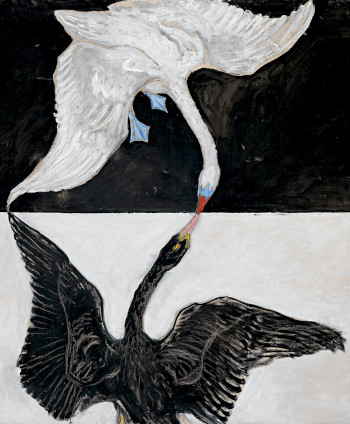
Hilma af Klint, a Swedish artist and mystic, used the swan to symbolize the "grandeur of the spirit," representing the evolution from duality to unity.
This painting, Swan No. 1. is a group of 24 oil on canvases Klint made between 1914 and 1915.
The Pazyryk Swan is a 2,300-year-old plush swan from Siberia tied to the creation of the universe. Made from reindeer wool that was processed into felt, the swan was discovered in a burial mound in the Pazyryk Valley of the Altai Mountains, near Russia's borders with Kazakhstan, China and Mongolia.
Music
"Seven Swans a-Swimming" is the gift given on the seventh day of Christmas in the classic carol, The Twelve Days of Christmas. Symbolically, they represent the seven gifts of the Holy Spirit (or seven spiritual gifts), which include prophecy, service, teaching, exhortation, giving, leadership, and mercy.
Ballet
Swan Lake (Russian: Лебединое озеро) is a ballet composed by Russian composer Pyotr Ilyich Tchaikovsky in 1875–76.
Odette is the "Swan Queen" and protagonist, a princess transformed into a white swan by the sorcerer Von Rothbart. She can only regain human form at night and seeks true love to break the curse. The ballet features her as the white swan (Odette) and her counterpart, the black swan (Odile).
Archeology
The idea that the human soul might take the form of a swan to journey from this world to the next could be one of the oldest fundamental beliefs of human kind, or so suggests a new discovery from the 420,000-year-old cave site of Qesem near Tel Aviv in Israel.
Archaeologists working in the Qesem cave site have found a single swan wing bone (a carpometacarpal) that bears clear knife marks indicating that the bird's feathers were purposely removed for some kind of specialist usage, most obviously ritual in nature.
Read Full ArticleStories
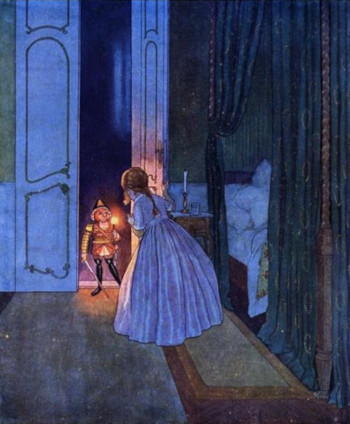
E.T.A. Hoffmann (1776–1822) was a German Romantic author renowned for blending dark fantasy, psychology, and surrealism in tales like Nutcracker and Mouse-King, (Original title: Nussknacker und Mausekönig). In this children's tale, swans are mentioned in three chapters.
Chapter 1 : Christmas Eve: Godfather Drosselmeier has told me of a lovely garden where there is a great lake, upon which beautiful swans swim about, with golden collars around their necks, and sing their sweetest songs. Then there comes a little girl out of the garden down along the lake, and coaxes the swans to the shore, and feeds them with sweet cake. "Swans never eat cake," interrupted Fred, somewhat roughly, and even Godfather Drosselmeier himself can't make a whole garden. After all, we have little good of his playthings; they are all taken right away from us again.
Chapter 12 : The Puppet Kingdom: Beautiful silver-white swans with golden collars, swam over the lake singing sweet tunes, while little diamond fish dipped up and down in the rosy water, as if in the merriest dance. "Ah," exclaimed Maria, ardently, "this is then the lake which Godfather Drosselmeier was once going to make for me, and I myself am the maiden, who is to fondle and caress the dear swans."
Chapter 13 : The Capital: The two golden-scaled dolphins raised up their heads, and spouted clear, crystal streams out of their nostrils, high, high in the air, which fell down again in a thousand quivering, flashing rainbows, and it seemed as if two small silver voices sang out: "Who sails upon the rosy lake? The little fairy—awake, awake! Music and song—bim-bim, fishes—sim-sim, swans—tweet-tweet, birds—whiz- whiz, breezes!—rustling, ringing, singing, blowing!—a fairy o'er the waves is going! Rosy billows, murmuring, playing, dashing, cooling the air!—roll along, along."
Swan Song
The swan song (Ancient Greek: κύκνειον ᾆσμα kýkneion ásma; Latin: carmen cygni) is a metaphorical phrase for a final gesture, effort, or performance given just before death or retirement. The phrase refers to an ancient belief that swans sing a beautiful song just before their death while they have been silent (or alternatively not so musical) for most of their lifetime.
The belief, whose basis has been long debated, had become proverbial in ancient Greece by the 3rd century BCE and was reiterated many times in later Western poetry and art. In reality, swans learn a variety of sounds throughout their lifetime; their sounds are more distinguishable during courting rituals and not correlated with death.
References and Related Info:
|
• Nutcracker and Mouse King | • Lohengrin: The Swan Knight | • Nutcracker and Mouse King |
Page Content
Interested in swan species, sounds, behavior and more?
Visit Swan Info Page
Site Spiritual Articles

| Comments |
|---|
| *1000 character limit |