 Click magic potion to change backgrounds


SPIRITUAL TEXTS
On this page are PDF files and site links to related texts. You may browse them here or download the files to read offline.
At the page bottom are links to various related websites.
Table of Contents
• The Yogas and Other Works by Vivekananda
• Bhagavad Gita
• The Vedas
• The Upanishads
• Assorted Texts Gayatri, Mahanirvana Tantra, Uddhava / Hamsa Gita
• Spirituality Links
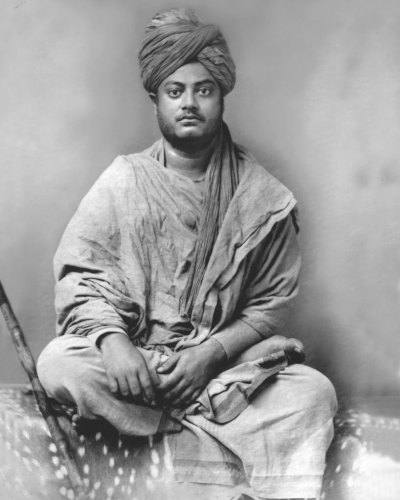
"True religion is not talk, or doctrines, or theories. It is the relation between soul and God.
We must realize God, feel God, see God, talk to God. That is religion".
VIVEKANANDA
Swami Vivekananda was a Hindu monk and one of the most celebrated spiritual leaders of India. He was more than just a spiritual mind; he was a prolific thinker, great orator and passionate patriot. He carried on the free-thinking philosophy of his guru, Ramakrishna Paramhansa forward into a new paradigm. He worked tirelessly towards betterment of the society, in servitude of the poor and needy, dedicating his all for his country. He was responsible for the revival of Hindu spiritualism and established Hinduism as a revered religion on world stage. His message of universal brotherhood and self-awakening remains relevant especially in the current backdrop of widespread political turmoil around the world. The young monk and his teachings have been an inspiration to many, and his words have become goals of self-improvement.
Book 1: Swami Vivekananda explains how to use the mind and intellect as tools for God-realization.
Books 2 & 3: Swami Vivekananda’s inspired writings on how to use work (karma) and loving devotion (bhatki) as paths to God.
Book 4: Called the “science of religion”, this book explains in detail how to reach God through meditation.
Note: This is not the complete 'The Yogas and Other Works' book content, which includes Swami's letters and poems etc.

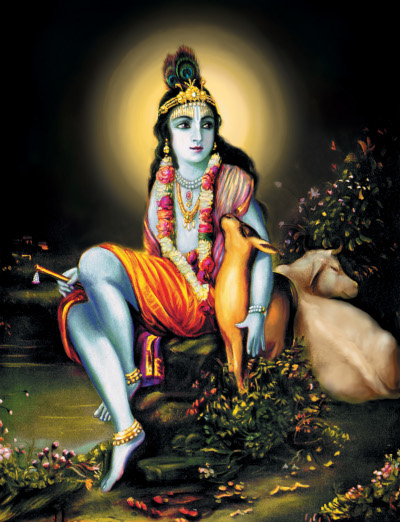
BHAGAVAD GITA
The Bhagavad Gita was written at some point between 400 BCE and 200 CE. Like the Vedas and the Upanishads, the authorship of the Bhagavad Gita is unclear. However, the credit for this text is traditionally given to a man named Vyasa, who is more of a legend than an actual historical figure; because of this, Vyasa has been compared to Homer, the great figure of ancient Greek epic poetry.
The Bhagavad Gita revolves around the following questions: How can someone live a life spiritually meaningful without withdrawing from society? What can someone who does not want to give up family and social obligations do to live the right way? The Gita challenges the general consensus that only ascetics and monks can live a perfect spiritual life through renunciation and emphasises the value of an active spiritual life. -source
 Bhagavad Gita (version 1) Translation by Sri Swami Sivananda
Bhagavad Gita (version 2) Translation by Lars Martin Fosse
Bhagavad Gita (version 3) Translation by Shri Purohit Swami
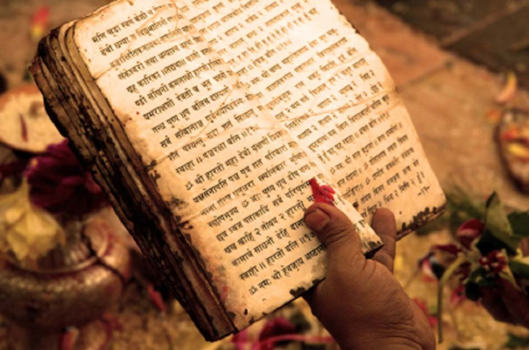
THE VEDAS
There are four Vedas; the Rig Veda, Sama Veda, Yajur Veda and Atharva Veda.
The Vedas are the primary texts of Hinduism. They also had a vast influence on Buddhism, Jainism, and Sikhism. Traditionally the text of the Vedas was coeval with the universe. Scholars have determined that the Rig Veda, the oldest of the four Vedas, was composed about 1500 B.C., and codified about 600 B.C. It is unknown when it was finally committed to writing, but this probably was at some point after 300 B.C. The Vedas contain hymns, incantations, and rituals from ancient India. They are among the most ancient religious texts still in existence.
Vedas (version 1) An English-only, indexed version of the 4 Veda Samhitas in one document.
Vedas (version 2)
Rig Veda Hymns Translated by Ralph T. H. Griffith, 2nd edition, Kotagiri (Nilgiri) 1896
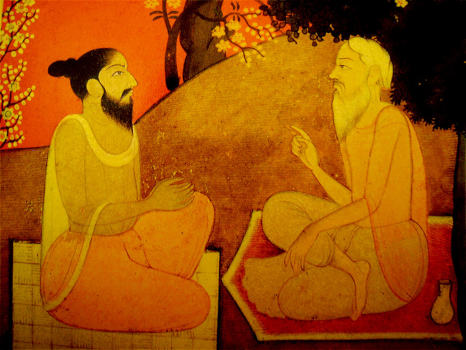
THE UPANISHADS
The Upanishads are a collection of texts of religious and philosophical nature, written in India probably between c. 800 BCE and
c. 500 BCE, during a time when Indian society started to question the traditional Vedic religious order.
Etymologically, the name Upanishad is composed of the terms upa (near) and shad (to sit), meaning something like “sitting down near”. The name is inspired by the action of sitting at the feet of an illuminated teacher to engage in a session of spiritual instructions.
There are over 200 surviving Upanishads, but only 14 are considered to be the most important. The names of these Upanishads are:
Isa, Kena, Katha, Prasna, Mundaka, Mandukya, Taittiriya, Aitareya, Chandogya, Brhadaranyaka, Svetasvatara, Kausitaki, Mahanarayana and the Maitri. -source
The Upanishads by Swami Nikhilananda
Yoga Upanishads PDF (see p.537-547)
Assorted Texts
Gayatri PDF Baba and the Gayatri-from Vision of the Divine (pp.79-88) The Great Liberation Mahanirvana Tantra - Arthur Avalon Uddhava Gita a.k.a. Hamsa GitaPage Content Sections
Site Spiritual Articles