
 Click magic potion to change backgrounds


Swan Info
Here are some basic swan facts. (The earthly variety, as opposed to celestial spirit swans).
Swan Species & Habitat
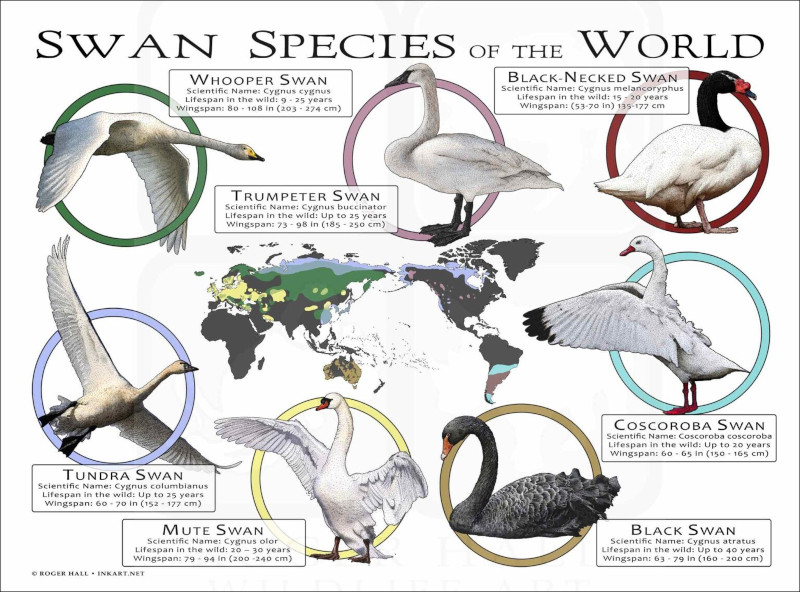
There are seven species of swan:
• Mute (Cygnus olor)
• Whooper (Cygnus cygnus)
• Trumpeter (Cygnus buccinator)
• Tundra (Cygnus columbianus)
• Black (Cygnus atratus)
• Black-necked (Cygnus melancoryphus)
• Coscoroba (Coscoroba coscoroba) -Sometimes considered a closely related, non-true swan.
The mute swan, trumpeter swan, whooper swan, and tundra swan live in the Northern Hemisphere.
The black swan, the black-necked swan, and the coscoroba swan live in the Southern Hemisphere.
Mute swans are not native to North America. Originally from Eurasia, they were first introduced in the mid to late 19th-century, as ornamental birds for parks and estates. The total native population of mute swans is about 500,000 birds at the end of the breeding season (adults plus young), of which up to 350,000 are in Russia.
Lifespan:
Mute swans typically live for 10–20 years in the wild, though many do not survive past 10 years due to environmental factors.
In protected, captive environments, they can live for 30–40 years.
Trumpeter Swans often live 20–30 years.
Tundra Swans have a median lifespan of roughly 10–15 years.
Black Swans have a maximum known longevity of over 24 years, with some reports suggesting they can reach up to 40 years.
The Whooper Swan lifespan in the wild is probably 10–15 years.
Physiology
Swan skin is generally black, which is most visible on their legs, feet, and the facial skin around their bills. While their feathers are typically pure white in Northern Hemisphere species, the underlying skin, including the lores (area between the eye and beak), is dark or black.
Because of this, in medieval symbolism, the swan represented a duality of purity and hypocrisy, or deception, serving as a high-status symbol of wealth, beauty, and courtly love, yet also representing the sinful soul hiding behind a holy exterior.
Swans have specialized physiology for swimming and filter-feeding, including waterproof feathers, powerful muscles, and serrated bills to graze aquatic plants. They maintain a high core body temperature and have specialized gizzards for digestion.
Swans have a high respiratory rate, and their breathing rate can increase significantly (up to 29 times) during heat stress. Vocalization: They possess a tracheal bulla, a specialized structure in the trachea that acts as a resonator for loud calls. Molting: Waterfowl, including swans, lose their flight feathers all at once, leading to a temporary period of being flightless, typically for 3 to 6 weeks.
Courtship, Mating, Pair Bonding
Swans are famously monogamous, often mating for life and reinforcing these strong bonds with elaborate, synchronized courtship rituals.
The process involves dramatic, mirrored movements — neck intertwining, head bobbing, and wing-lifting — followed by the male (cob) mounting the female (pen) in the water, which often involves intense splashing and submersion. Pairs face each other, dipping heads, and often forming a heart shape with their necks.
Swans go through this ritual many times during the breeding season, far more often than is required to fertilise the eggs. The ‘extra’ mating rituals may strengthen and support the bond between the pair.
Eggs & Cygnets
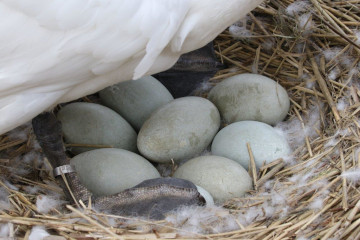 Swan eggs are among the largest produced by flying birds, measuring up to 5 inches long and weighing around 350g, with thick shells strong enough to support an adult swan.
During the breeding season, female swans can produce an egg once every other day, or so.
The average number of eggs produced by a pair of Mute Swans is about six, but a range of four to eight is quite common. Swan eggs are incubated for roughly 33 to 42 days (typically 5 weeks), with both parents often sharing duties, though the female (pen) does the majority of the sitting.
Eggs are laid over several days but hatch within a day of each other. Incubation usually begins after the full clutch is laid.
Young swans are called cygnets. They are typically born with grey or white down feathers, which turn brown/grey during their first few months before transitioning to white by their first year. They are highly precocial, swimming and foraging for aquatic vegetation, insects, and small fish shortly after hatching. Often, they ride on their parents' backs for warmth and protection.
Cygnets depend on their parents for 4-12 months. They typically take 3 to 4 years to reach full sexual maturity and begin breeding, although some may start as early as 2 or as late as 6 years. While they fledge within 3-4 months, they remain in immature flocks until they are ready to find a mate and establish a breeding territory.
Swan Sounds
Mute Swan (Cygnus olor) Flying, flapping, calling, grunting
Despite their name, Mute swans make a variety of sounds, although they are generally quiet birds. Swans produce resonant, sonorous, loud, low-pitched, bugle like calls. Or high pitched often quavering oo-oo-oo, accentuated in the middle; or who, who-ho: woo-oo-woo; or who-who.
Hissing sounds are common and occasional snorting noises.
Behaviors
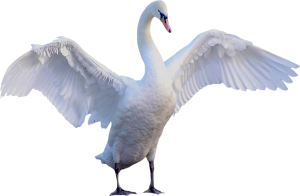
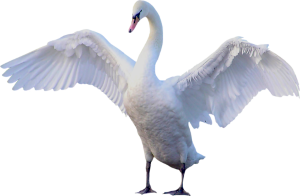
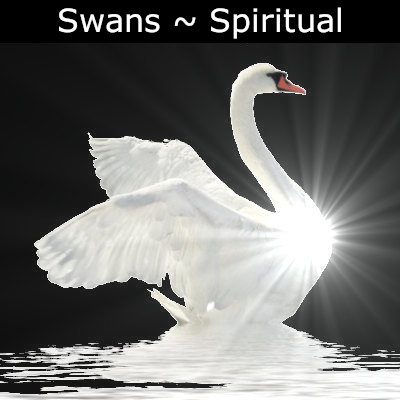
Swans spread their wings primarily to display aggression, defend territory, or intimidate threats, a behavior often called "busking".
By arching their wings like sails, they appear larger, which warns off rivals or predators. Swans also hiss when they feel threatened.
If the interloper continues to hang around, the behaviour may escalate to lunging/attacking.
They also spread and flap wings to dry feathers, or stretch after swimming.
Mute Swans + Hissing
Quirks: Homosexuality is common in swans, particularly Black Swans, with studies showing up to 20-25% of pairs being same-sex, often forming stable, lifelong bonds and successfully raising offspring by adopting abandoned eggs or taking eggs from females after mating. These male-male pairs can be more successful parents, achieving up to 80% chick-raising success due to better territory defense and shared workloads, compared to around 30% for heterosexual pairs.
Swan Diet & Feeding
Swans are primarily herbivores. Those living on fresh water will typically eat pondweed, stonewort and wigeon grass, as well as fish, tadpoles, and insects such as milfoil.
Swans living on salt water will typically eat sea arrow grass, salt marsh grass, eel grass, club rush and green algae, as well as insects and molluscs.
Swans play a vital role in maintaining the health of aquatic ecosystems. By eating plants and small aquatic animals, they spread seeds and aquatic animal eggs through their feces, supporting the growth of plants and the survival of animal species. While swimming, they also stir up sediment, which helps circulate nutrients around these bodies of water, supporting the health of the plants and fish that live below.
Migration
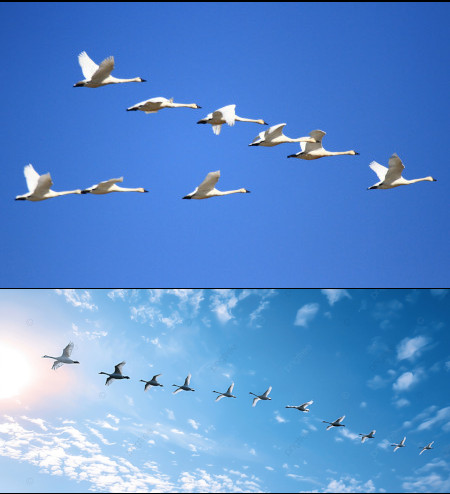 Swans, including Tundra and Trumpeter species, are migratory birds that travel in small, often V-shaped family groups from Arctic or northern breeding grounds to warmer southern water bodies, covering thousands of miles. They migrate
by day and night from mid-September to November, returning north between February and April.
Swans, including Tundra and Trumpeter species, are migratory birds that travel in small, often V-shaped family groups from Arctic or northern breeding grounds to warmer southern water bodies, covering thousands of miles. They migrate
by day and night from mid-September to November, returning north between February and April.
Energy Efficiency: The V-shape, or echelon formation, helps birds manage long-distance flights by allowing them to utilize the "upwash" of the bird in front.
While V-shapes are common, swans may also fly in straight lines.
The lead bird, which faces the highest wind resistance, will often swap with others to share the workload.
North America's Tundra Swans nest in the arctic, and migrate for the winter either east to the Atlantic Flyway to the Chesapeake area, or west to California. Their migrations can overlap areas where Trumpeter Swans have been nesting or winter (especially in the Pacific Northwest).
Mute swans are generally non-migratory, year-round residents that stay in the same area unless forced to move by freezing water, which restricts their food source. While they do not engage in traditional long-distance migration, they may shift to coastal waters, larger lakes, or open rivers during winter.
Predators
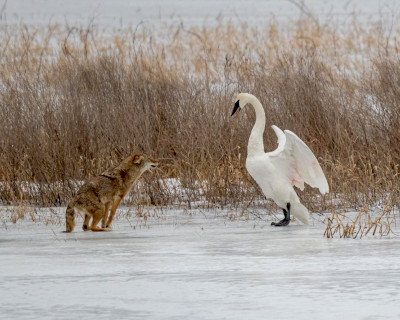 Adult swans have few natural predators due to their size and aggression, but eggs and young cygnets are frequently preyed upon by foxes, mink, raccoons, coyotes, wolves, bears, eagles, and large fish like pike.
Humans are the primary predator of adult swans through hunting, poaching, and habitat destruction, while domestic dogs or cats may also attack them.
Hunting
Mute swans are considered a highly invasive species in North America, damaging wetlands and aggressively displacing native waterfowl. They are not protected by the federal Migratory Bird Treaty Act. It's legal to hunt and eat swans in some states. Swan advocates argue there is no scientific data proving mute swans are more detrimental to the environment than other waterfowl.
Hunting legality is based on Junk ScienceMute Swan Hunting Objections
Save Our Swans NY
References and Related Info:
|
• Swanlife.com Mute Swans • Trumpeter swan society |
• Mute Swan Sound Collection |
• Swan Sanctuary UK • Swan Upping UK |
Page Content
Interested in swan mythology, folklore, and more?
Visit Swan Lore Page
Site Spiritual Articles

| Comments |
|---|
| *1000 character limit |